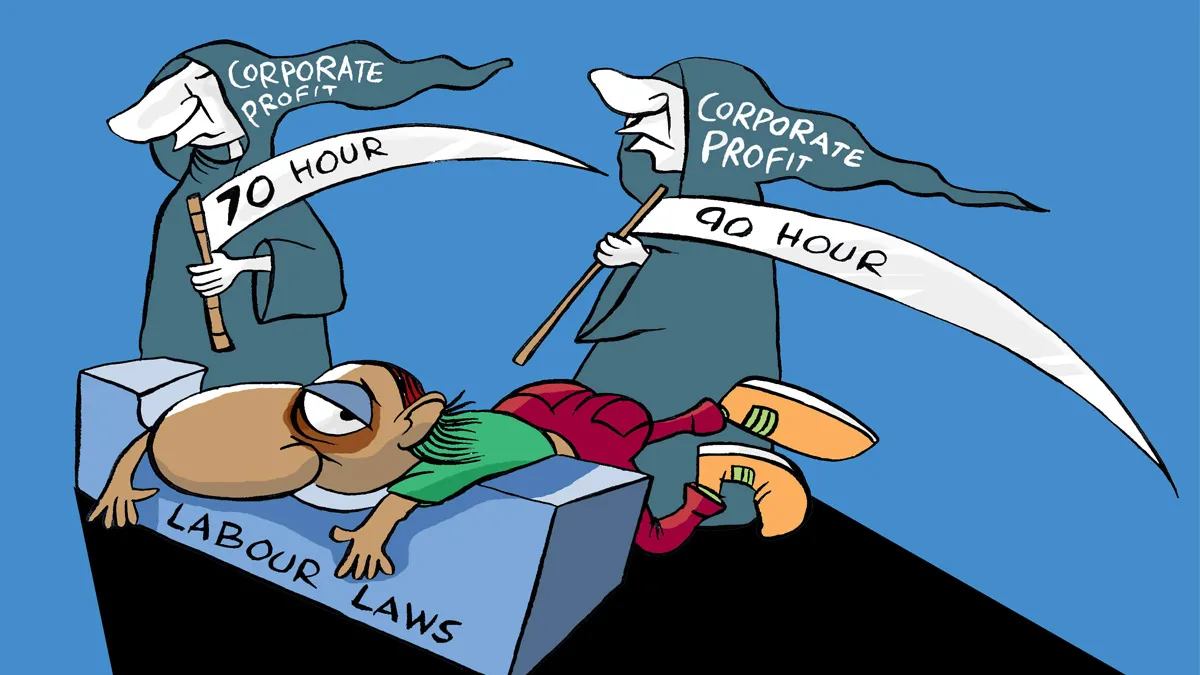
The Indian government is pressing all states and Union Territories (UTs) to publish their rules under the four new labour Codes by October 31, aiming to fully operationalise the new labour law framework. This move is crucial as labour falls under the concurrent list, requiring state-level rule-making for effective implementation.

A section of industry may need to begin compliance immediately, even as most states are yet to notify their rules.
The Indian government has notified final rules under four labour codes, potentially enabling a four-day workweek in certain sectors by capping weekly working hours at 48 while allowing daily flexibility. This move also introduces significant changes to wage fixation, compliance obligations, and social security norms.
In a historic decision, the government on Friday announced the implementation of the four Labour Codes, which rationalised 29 existing labour laws, with immediate effect. The four labour codes are -- the Code on Wages, 2019, the Industrial Relations Code, 2020, the Code on Social Security, 2020 and the Occupational Safety, Health and Working Conditions Code, 2020.

Companies would have to recognise the increase in gratuity liability arising from new labour codes in their interim financial statements and results for the period ending December 31, the Institute of Chartered Accountants of India (ICAI) has said in its FAQs on the new labour codes.

The new labour Codes, notified by the central government in November 2025, have pushed up employee costs for private-sector banks and insurance companies, with these firms reporting higher operating expenses in the October-December quarter (Q3FY26) due to the statutory impact of the new labour Codes.

India's Code on Wages mandates strict payout deadlines, two-day full and final settlements, universal wage coverage and capped deductions to safeguard employees and enhance payroll transparency nationwide.
While the move may give a competitive edge over rivals like Bangladesh in the global market, several industry bodies raised concerns that many state governments may not implement it on the ground.

From appointment letters becoming mandatory to gig workers receiving social security to enhanced rights for women and contract labour, the changes reflect India's attempt to balance ease of doing business with stronger worker welfare.

'It will increase the contribution to gratuity, which is something the employer has to give.'

'Companies will need to revisit compensation structures, contracts, staffing models, and human resources system.'
The four labour codes on wages, social security, industrial relations and occupation safety, health and working conditions are likely to be implemented by the next fiscal year as at least 13 states have pre-published draft rules on these laws, a senior official said. The Centre has already finalised the rules under these codes and now states are required to frame regulations on their part as labour is a concurrent subject. A senior official said that the four labour codes are likely to be implemented by the next fiscal year.
Union Labour Minister Bhupender Yadav has exuded confidence that four labour codes, which would bring another wave of reforms, will soon be implemented as around 90 per cent of states have already come out with draft rules. In 2019 and 2020, 29 central labour laws were amalgamated, rationalised and simplified into four labour codes, viz, the Code on Wages, 2019; the Industrial Relations Code, 2020; the Code on Social Security, 2020; and the Occupational Safety, Health & Working Conditions Code, 2020, noted the Survey. During an interaction, Yadav told reporters that around 90 per cent of the states have already published draft rules on four labour codes and he expects the four legislations would become operational soon.

Labour Minister Santosh Gangwar said, the purpose of labour reforms is to provide a transparent system to suit the changed business environment.

Their implementation is expected to create investment owing to improving ease of doing business as well as initiating pro-worker measures.
Day 6 of Parliament's monsoon session 2020. Watch all the action in both houses LIVE here.

This will help employers keep a track of the diseases workers could suffer from while doing their jobs.
The Union government will take a bit longer to introduce the much-awaited labour codes even as the majority of states and Union Territories (UTs) have framed rules on them. There were speculations that these would be introduced from July 1. While 30 states and UTs have framed rules on the code on wages, 25 of them have done so on industrial relations. Of the two remaining codes, 24 states and UTs have framed rules on social security and 23 on occupational safety, health, and working conditions (OSH), sources said.
All four labour codes are likely to be implemented in one go from April 1, the beginning of the next fiscal year, labour secretary Apurva Chandra said on Wednesday. The parliament in its just concluded session passed three labour code bills: the Industrial Relations (IR) Code, the Social Security Code, and the Occupational Safety, Health and Working Conditions Code (OSH). The Wage Code Bill, 2019 was passed by the parliament last year.

The move will help industries in pushing authorities for exemption under various labour laws at a micro-level, along with demanding changes to bring greater flexibility in their operations related to retrenchment, safety standards, and collective bargaining.

The government has introduced the Code on Wages Bill 2019 and the Occupational Safety, Health and Working Conditions Code Bill 2019 in Lok Sabha on July 23.
The four labour codes will not come into effect from April 1 as states are yet to finalise the relevant rules, which means that there will be no change in take home pay of employees and provident fund liability of companies for now. Once the wages code comes into force, there will be significant changes in the way basic pay and provident fund of employees are calculated. The labour ministry had envisaged implementing the four codes on industrial relations, wages, social security and occupational health safety & working conditions from April 1, 2021. The ministry had even finalised the rules under the four codes.

Working hours cannot go beyond 48. Those who give a four-day week will have to provide three consecutive holidays after that.
The four labour codes are unlikely to be implemented this fiscal in view of slow progress on the drafting of rules by the states and also for political reasons like elections in Uttar Pradesh, a source said. The implementation of these laws assumes significance because once these are implemented there would be reduction in take-home pay of employees and firms have to bear higher provident fund liability. "The ministry of labour is ready with the rules under the four labour codes. But the states have been slow in drafting and finalising those under new codes.

The National Investigation Agency (NIA) has started interviewing eyewitnesses, including tourists, in connection with the deadly terrorist attack in Pahalgam, south Kashmir. The attack, carried out by terrorists from the Pakistan-based Lashkar-e-Taiba (LeT), claimed the lives of 26 people on April 22. Initial investigations suggest that five to seven terrorists were involved, aided by local militants trained in Pakistan. Security forces are conducting massive operations to hunt down the terrorists in the dense jungles of the Pir Panjal range.
Ushering in a big wave of reforms by implementing the four labour codes, setting up the national social security fund to cover over 38 crore informal sector workers and improving the ease of doing business will top the agenda of the labour ministry in the New Year. In a major move, the ministry launched the e-Shram portal on August 26, 2021 for creating a national database of over 38 crore informal sector workers. It will help the government to ensure last-mile delivery of benefits of various social security schemes to the informal-sector workers.

'In India, managers and the leadership almost glorify overworking.'

The Union government is projected to share about 32 per cent of central taxes with states during the financial year 2024-25 against the 15th Finance Commission's recommendation of 41 per cent. The Revised Estimates (RE) for FY24, too, show a similar share of states in the central taxes at 32 per cent. In absolute terms, however, there has been an increase in the amount devolved to states compared to the Budget Estimates (BE) for FY24 at Rs 11 trillion.

The recent protests by employees of Urban Company and the case of a a Zomato delivery executive who died in a road accident point to the severely straitened condition of gig workers during the ongoing Covid-19 pandemic. Budget 2021 had promised several measures to help the cause of gig economy workers, but most of them are yet to see the light of day. Even after a year, the country's gig workers continue to be without any social security cover or a minimum wage guarantee. "In Budget 2021, finance minister Nirmala Sitharaman had announced that the government is looking toward including migrant and gig workers for social security benefits," says Srinivas Kotni, managing partner, Lexport, a consulting firm. Parliament had passed the Code on Wages in 2019 and Code on Industrial Relations, Social Security and Occupational Safety, Health and Working Conditions in 2020.

As per the recommendations of the 2nd National Commission on Labour, the ministry is codifying existing 44 central labour laws into four codes by simplifying, amalgamating and rationalising the relevant provisions of the legislations.

The implementation of four labour codes in one go from April 1 next year will usher in a new wave of reforms in industrial relations and also help in attracting more investments but employment generation will remain a key challenge in 2021. This year has also been a challenging year for the work force as well as for employers due to the outbreak of the COVID-19 pandemic. The government imposed a nationwide lockdown from March 25, which had an adverse impact on economic activities and resulted in exodus of migrant workers from large cities to their homes in the hinterland. Many migrant labourers lost their jobs and it took months for them to return back to their work places from their native places.

After assuming power in 2014 with a full majority of its own, the BJP-led NDA government started an ambitious process of reforming labour laws in the form of codes aimed at making the framework less cumbersome with a variety of alterations. It had planned four codes each for industrial relations, wages, social security and welfare, and occupational safety, health and working conditions. To this end, 35 central labour laws were to be converted into four codes that would have had the virtue of streamlining labour relations. But none of the proposed code Bills could be converted into a law principally because neither trade unions nor industry representatives came on board. They hold the key to India's low-growth-high unemployment paradigm but the government may struggle to push them through this time as well. Somesh Jha explains why

The norms, say industry experts, are not sufficient to weed out fly-by-night contractors.

Single registration will be coupled with single licence, along with a single return, for executing projects for five years.

However, the government has enacted an important change to the fixed-term employment framework that may help companies in handing out contractual jobs to its existing permanent workforce.

Students can be imposed a penalty of Rs 20,000 for holding dharnas and face admission cancellation or a fine of up to Rs 30,000 for resorting to violence at Jawaharlal Nehru University, its latest rules stipulate.

According to police, the bike was in front of the car but the sequence of events which led to the accident is yet to be established and CCTV cameras are being scanned to ascertain the cause of the collision.

The Bill states a worker will be paid twice his or her wage if he or she is allowed to work overtime. A majority of workers in India worked more than 48 hours in a week, which is higher than the International Labour Organisation's prescribed time-limit.

Three persons have been booked in connection with the devastating fire in a residential building in the powerloom town of Bhiwandi here that gutted two of its floors and left several residents stranded for hours.

